Most of us don't give a second thought to the little snowflake button on the dashboard until it stops blowing cold air on a humid afternoon. Suddenly, that AC system feels like the most important piece of technology ever invented. Looking back at how we got to this point is actually a wild ride. Early car owners had to be incredibly creative, and very brave, just to keep from melting inside their vehicles.
The Days of Open Windows and Block Ice
In the very early days of motoring, air conditioning was a luxury that didn't exist. If you were hot, you rolled down the windows or folded out the windshield to get some airflow. However, as cars moved from open carriages to enclosed steel boxes, they basically became rolling ovens.
The first real attempt at cooling things down involved the car cooler. This was a cylindrical device that hung off the side window. It worked on the principle of evaporation. You would fill it with water, and as the car moved, air would pass through the wet pads and blow cool mist into the cabin. It worked reasonably well in the desert, but in a humid climate, it just made everyone feel like they were sitting in a sauna.
The Breakthrough of the 1930s and 40s
Real, refrigerated air conditioning finally made its debut in 1939. Packard was the pioneer here, offering a system that was essentially a giant refrigerator crammed into the trunk. While it was revolutionary, it had some major design flaws that would drive a modern driver crazy:
There was no thermostat. The system was either full blast or completely off. To turn it off, the driver actually had to get out of the car, pop the hood, and manually remove a belt from the compressor. The cooling coils and blowers took up almost the entire trunk, leaving no room for luggage.
Because these systems were so expensive, costing nearly a quarter of the price of the car itself, they didn't exactly fly off the lots. It took a few more decades for the technology to become compact and affordable enough for the average family car.
The Rise of the Modern System
By the 1950s and 60s, manufacturers like Pontiac and Nash figured out how to move the entire AC unit under the hood, which is where it remains today. This era saw the introduction of the magnetic clutch, which allowed the compressor to cycle on and off without the driver needing to pull over and mess with belts.
This was the golden age of R-12 refrigerant, often called Freon. It was incredibly effective at cooling, but as we later learned, it wasn't great for the ozone layer. This led to a massive shift in the 1990s toward R-134a, a more environmentally friendly gas. If you have ever brought an older classic car into our shop, you might know about the conversion kits we use to update those old R-12 systems to modern standards.
How AC Works Today
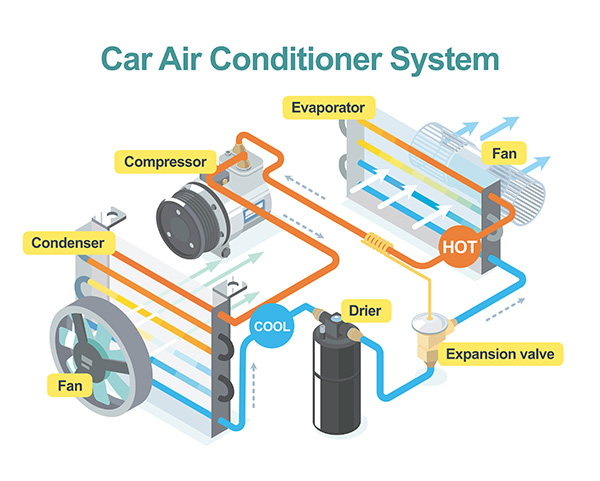
Today’s auto AC systems are remarkably complex compared to those old trunk-mounted units. Today, your car uses a series of sensors to monitor cabin temperature, humidity, and even the angle of the sun hitting the dashboard. The system then adjusts the blend doors and fan speeds to keep you perfectly comfortable without you ever having to touch a dial.
We have also seen a shift toward R-1234yf, a new refrigerant that is even better for the environment. These systems operate under different pressures and require specialized equipment to service, which is why DIY recharge kits from the local parts store can often do more harm than good on newer vehicles.
Why Maintenance Matters More Than Ever
Because modern AC systems are so integrated into the car's computer and engine cooling system, a small leak can lead to a big headache. The refrigerant doesn't just cool the air; it also carries a specific type of oil that lubricates the compressor. If your gas is low, your compressor is likely running dry, which can lead to a total system meltdown.
Common signs your AC needs a professional look:
- A musty or moldy smell coming through the vents when you first turn it on.
- A subtle whistling or hissing sound behind the glovebox.
- The air feels cool but never truly cold, even on the highest setting.
- The engine feels like it is struggling or vibrating more than usual when the AC is engaged.
History shows that we have come a long way from hanging buckets of water off our windows. Your car is a masterpiece of climate control engineering, and it deserves to be treated that way.
Auto A/C Repair at Oceanworks Berkeley
Bring your vehicle by Oceanworks Berkeley in Berkeley, CA for an AC performance test. We will check your pressures, hunt for leaks with UV dye, and make sure your cabin filter is clean so you can breathe easy. We love talking shop and keeping our neighbors comfortable on the road.
Give us a call or drop in to see us this week!